The Post-Meeting Routine That Turns Booked Calls Into Closed Deals
Short answer: Learn the post-meeting system that turns a strong sales call into a closed deal: review, next steps, and follow-up done right.
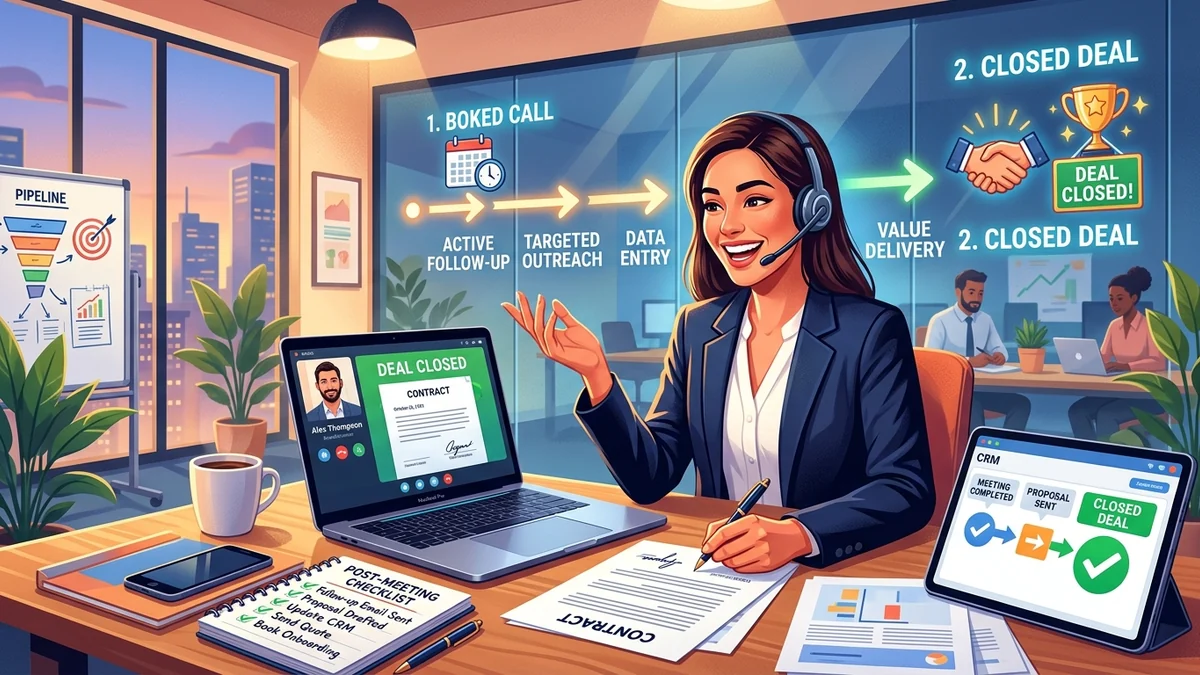
The meeting went well. The prospect asked sharp questions, seemed genuinely interested, and said "let's keep this moving." You hung up feeling solid. Then a few days passed. Then a week. Then you sent a follow-up email that started with "Just checking in" and heard nothing back. That is not a sales problem. That is a post-meeting problem, and it is far more common than any rep wants to admit.
The 24-Hour Window
Scheduling the meeting is only half the job. What you do in the 24 hours after a call determines whether the deal moves forward.
- Most deals stall not because the call went badly, but because follow-through was vague or delayed.
- A repeatable post-meeting routine gives every conversation a clear path to the next stage.
- Reviewing specifics, assigning ownership, and sending a targeted follow-up within hours separates reps who close from reps who lose to silence.
Why Deals Die in the Days After a Great Call
Most sales training is focused on the call itself. Objection handling, rapport building, discovery questions. Those things matter, but the moments after you hang up rarely get the same attention. That is exactly where momentum goes quiet.
Prospects talk to multiple vendors. Their attention moves on fast. If your follow-up lands three days later and reads like a template pulled from a shared drive, you have already lost ground. The rep who sends something specific and thoughtful within hours of the call is the rep who stays front of mind. The rep who waits loses to whoever moved faster.
The real issue is that most reps treat the post-meeting phase as optional. They rely on memory, put off the follow-up until they "have time," and skip the internal debrief entirely. By the time they get around to writing the email, the details that made the conversation meaningful have blurred together into a vague impression of "it went well."
The Debrief You Keep Skipping
Right after a call ends, most reps jump straight to their next task. A quick break, another meeting, the first distraction that crosses their screen. The call fades fast. That is a problem, because the review stage is where good intentions turn into clear action.
Blocking 10 to 15 minutes immediately after a call is not a luxury. It is the single step that makes every other step possible. During that window, you ask yourself a focused set of questions: What did the prospect say they care about most? Where did the energy shift in the conversation? What hesitation came up? What did they ask about that you did not fully address?
This is not a long, drawn-out process. It is a focused habit that takes less time than scrolling through notifications. The goal is to capture the signal before it fades, and to do it while the conversation is still vivid in your mind.
Capturing the Conversation While Details Are Still Alive
Research on how memories fade shows that people forget the majority of what they heard within hours without active reinforcement. For sales reps running back-to-back calls, that window is even shorter. The specific phrases, the hesitations, the moments of real interest , those details are gone faster than most people realize.
The traditional fix was to take notes during the call. But note-taking pulls you out of the conversation at the worst moments. You miss a subtle shift in tone, a hesitation before a key answer, or the exact phrase a prospect used to describe their pain point. You end up half-present, and prospects tend to notice.
A better approach is to use meeting transcription to capture a verbatim record of the entire call automatically. Instead of trying to document and listen at the same time, you stay fully present during the meeting and have an accurate, searchable record waiting for you when it ends. That record becomes the foundation for everything that comes next: the debrief, the next steps, and the follow-up email.
When you sit down for your post-call review, you are not working from a hazy impression. You are working from what was actually said, in the prospect's actual words. That distinction matters more than most reps appreciate.
"The rep who references specifics from the conversation earns trust faster than any pitch deck ever could. It signals one thing above all else: you were actually listening."
Translating Key Moments Into Concrete Next Steps
After reviewing the call, the next priority is to assign clear actions. Not vague intentions, but specific tasks with owners and deadlines , for your side of the table and the prospect's side.
Vague next steps are deal killers. "We'll be in touch" is not a next step. "I'll send you the case study from a comparable company by Thursday, and you'll confirm with your team whether a technical review makes sense by end of next week" is a next step. That level of specificity creates a shared expectation. It also makes the follow-up email feel like a natural continuation of the conversation rather than a cold reach-out from a stranger.
One thing worth doing during the review is writing down the prospect's stated priorities in their own words. Not your paraphrase of what they meant, but the actual phrases they used. That vocabulary shows up in your follow-up email, and it lands completely differently when the prospect reads their own language reflected back at them with clarity and care.
Writing a Follow-Up That Feels Like It Came From a Human
The follow-up email is where the entire post-meeting routine pays off. Done well, it reinforces the prospect's confidence in talking to you. Done poorly, it confirms you were not paying attention.
A strong follow-up does four things. It references something specific from the conversation, not just "great talking today." It summarizes the key themes the prospect raised in their own terms. It confirms what each party will do next, with clear timelines. And it opens a door without demanding a response or applying pressure.
The reference to something specific is the part most reps skip, and it is also the part that makes the biggest difference. Mentioning a challenge the prospect described, a goal they shared, or a question they raised signals that you were genuinely present. It creates a shared frame of reference that makes the next conversation easier to start and harder to ignore.
Aim to send the follow-up within two hours of the call ending. Not two days. Not "end of the week." The sooner it arrives, the more it reads as a natural extension of the conversation and the more confident the prospect feels that you are the kind of partner who follows through.
A Repeatable Post-Meeting System in Five Steps
The goal of any good routine is to remove the need to make decisions in the moment. When the steps are clear, you run them without thinking. Here is a post-meeting system you can apply after every sales call:
- End the call and block 15 minutes immediately. Do not move on to your next task until the review is done. Protect this time as you would any client-facing meeting , it is not optional.
- Pull up the call transcript and identify three key moments. Look for moments where the prospect expressed urgency, described a specific challenge, or raised a concern. These are the moments your follow-up must reflect.
- Write down the prospect's priorities in their exact words. Capture the phrases they used to describe their situation. This language belongs in your follow-up email and your CRM notes.
- Assign every next step an owner and a deadline. Both your actions and theirs. Log them before the review window closes , not later, not tomorrow, now.
- Write and send the follow-up email within two hours. Keep it focused and specific. Reference what was said, confirm next steps, and close with a clear, low-pressure prompt toward the next meeting or action.
Running this routine consistently creates a compound effect. Each conversation gets a proper close. Deals that might have drifted continue moving forward. And over time, prospects begin to notice that you are the rep who follows through every single time.
The Habit That Makes Winning Deals Feel Repeatable
Closing deals consistently is not about charm or luck. It is about building a system that respects the prospect's time and captures the value of every conversation you have. The call opens the door. The 24 hours after it determine whether you walk through.
Reps who close at a high rate are not necessarily better at talking. They are better at following through. They review fast, assign clearly, and follow up with something that proves they were genuinely present. That combination is rarer than it should be in most sales environments, and that is precisely why it works.
Building a post-meeting routine is a one-time investment that pays back on every call you take from here forward. Start with the five steps above. Run them after your next call. Refine where something feels off. Within a few weeks, you will not need to think about the routine anymore. It will simply be what you do, and the results will reflect it.
Continue with the first-party Meetin.gs scheduling field guides or use the meeting resource center to move from this contribution to product help, comparisons, and practical tools. Guest work is reviewed under the Meetin.gs editorial policy.
